documentation
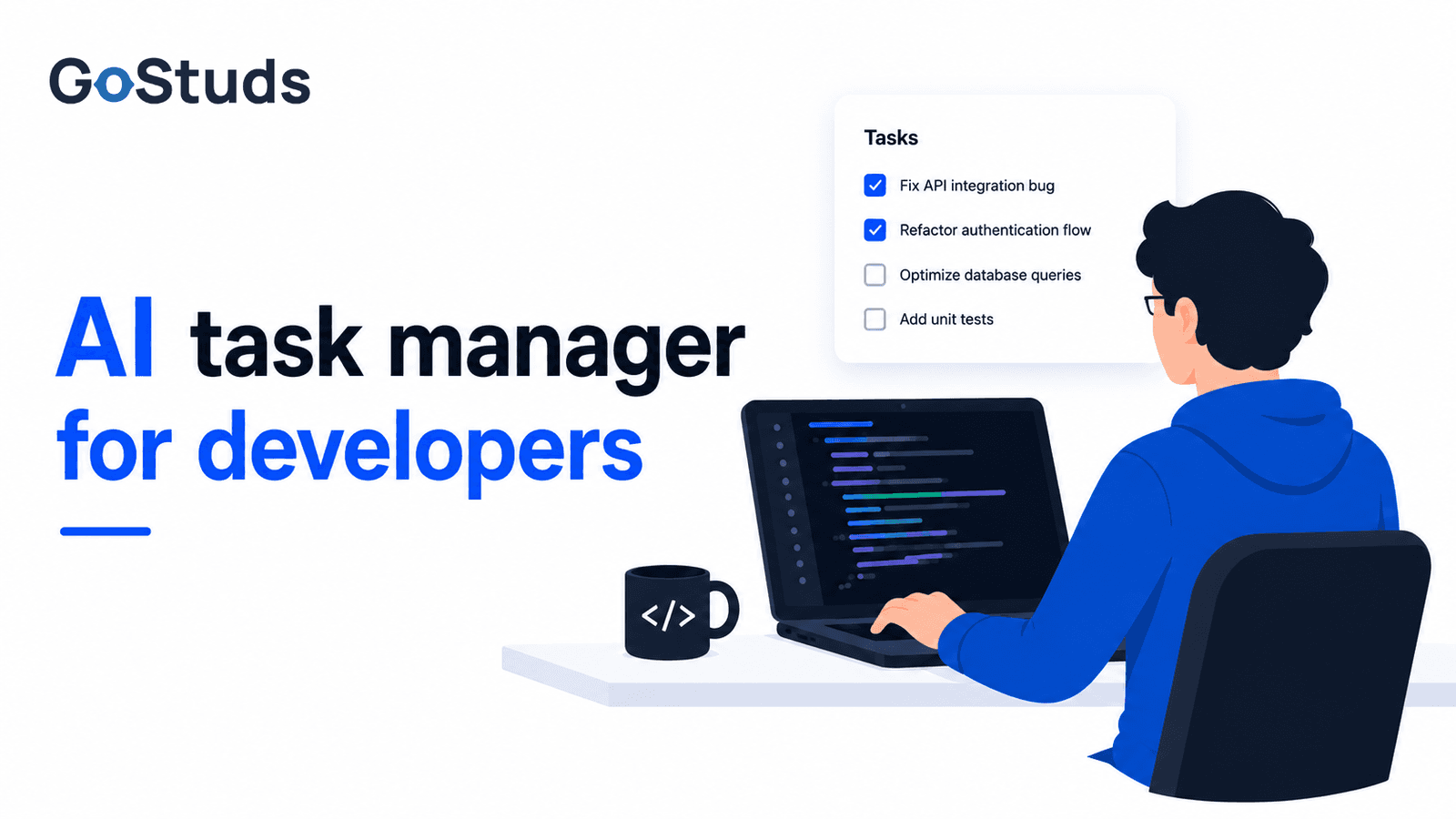
The AI Task Manager That Understands How Developers Think About Work
GoStuds Team
The GoStuds team writes about AI project management, developer productivity, and building software products faster.
May 6, 2026
7 min read
Developers do not think in terms of generic to-do lists. They think in terms of services, APIs, database migrations, test coverage, code review, and deployment stages. Generic task managers do not understand this. They give developers the same flat task list they give marketers and project managers — missing the technical hierarchy, dependency relationships, and workflow states that make task management actually useful for engineering work.
GoStuds is the AI task manager built from the ground up for developers. It generates tasks from system architecture, understands technical dependency chains, manages developer sprint workflows with appropriate states, and tracks progress without adding administrative burden to the people who should be focused on writing great code.
GoStuds developer task manager starts with architecture — because every development task exists to implement some part of the system architecture. This is what makes GoStuds fundamentally different.
GoStuds sprint management is built around how development teams actually work — with technical workflow states, code review integration, and sprint planning that understands engineering complexity.
In GoStuds, every developer task carries its full technical context — what part of the architecture it implements, what it depends on, and what it enables. This eliminates the constant back-and-forth between developers and PMs about what work means.
GoStuds tracks developer progress from task state changes rather than requiring developers to write status updates. The information flows from the work itself.
| Feature | GoStuds | Linear | Jira | GitHub Projects | ClickUp | Asana | Trello |
|---|---|---|---|---|---|---|---|
| Architecture-Generated Tasks | Yes | No | No | No | No | No | No |
| Developer Workflow States | Yes | Yes | Yes | Partial | Partial | No | No |
| AI Sprint Planning | Yes | No | No | No | Limited | No | No |
| Architecture Context in Tasks | Yes | No | No | No | No | No | No |
| PR Integration | Yes | Yes | Yes | Yes | Partial | No | No |
| Free to Start | Yes | Yes | Yes | Yes | Yes | Limited | Yes |
An AI task manager for developers is a task management tool built specifically for software development workflows — with features like code review stages, architecture-linked tasks, technical dependency tracking, and sprint management that understands engineering complexity. The AI layer generates tasks from architecture, plans sprints intelligently, and tracks progress from code activity rather than manual updates.
Linear is an excellent developer task manager with a clean, fast interface and good GitHub integration. GoStuds adds what Linear lacks: AI system architecture generation that creates the task backlog, AI sprint planning that proposes optimal sprint compositions, and architecture context embedded in every task. For developers who need a task manager connected to technical planning and architecture, GoStuds is more complete than Linear.
GoStuds and GitHub Projects serve different purposes. GitHub Projects is tightly integrated with your code repository for code-centric project tracking. GoStuds is the technical planning and task management layer above the code — where architecture is designed and tasks are planned before (and alongside) development. Most GoStuds users keep their code in GitHub while managing project planning and task coordination in GoStuds.
GoStuds architecture generation supports any technology stack — the AI produces architecture descriptions that are stack-agnostic and then applies stack-specific implementation details when you specify your language, framework, or infrastructure preferences. Task descriptions reflect the appropriate technical vocabulary for each part of the stack, whether frontend JavaScript, backend Python, database SQL, or infrastructure Terraform.
Yes. GoStuds is popular with solo developers and indie hackers who use it as their personal AI task manager for their own projects. The AI architecture generator helps a solo developer plan what to build. The sprint management helps them organize their own execution. And documentation features help them maintain project context that is often lost when working alone without a team knowledge base.
A: GoStuds AI estimates story points based on multiple signals: the complexity of the architectural component the task implements, the historical velocity data for similar task types in your team's sprint history, and the technical dependencies the task requires. These signals combine into a story point estimate that improves in accuracy over time as GoStuds learns your team's velocity patterns.
A: GoStuds supports technical debt as a dedicated task category with priority scoring and sprint impact assessment. Developers can flag tasks as technical debt during code review, and engineering managers can see the accumulation of technical debt tasks alongside feature development tasks in the sprint planning view. AI sprint planning can balance debt reduction against feature development based on configurable debt-to-feature ratios.
A: GoStuds supports webhook integrations that can receive signals from CI/CD pipelines. When a build completes or a deployment succeeds, connected tasks can be automatically updated. This enables task states to reflect deployment reality rather than requiring developers to manually update task status after each deployment step.
A: GoStuds AI prioritization considers multiple dimensions: architectural dependencies (what must be built before other things can start), milestone timeline impact (which tasks are on the critical path to the next milestone), and strategic priority tags. When everything seems urgent, AI sprint planning provides a structured proposal that reflects actual architectural dependencies rather than gut-feel priority — helping developers focus on work that unblocks the most subsequent work.
A: GoStuds supports sprint-based agile workflows (scrum) and continuous-flow kanban workflows. Developers who prefer time-boxed sprints use the sprint planning features. Developers who prefer continuous flow use the kanban board with AI prioritization. Both workflows benefit from architecture-generated tasks and AI-assisted planning — only the sprint structure differs between the two approaches.
Stop creating tasks by hand in a system that does not understand what you are building. GoStuds AI task manager for developers generates tasks from architecture, plans sprints intelligently, and tracks progress automatically — so you can focus entirely on writing great code.
Written by
GoStuds Team
The GoStuds team writes about AI project management, developer productivity, and building software products faster.
Build your idea with the right team
Find teammates and co-founders, manage projects, and ship faster on GoStuds.